Saturday 17th October saw the first face-to-face gathering of the Caecilius UK community for some years. While our online events have been very successful in reaching teachers across the world, it was wonderful to be together in Cambridge for the 60th birthday of the Project. Here you can read about the highlights of the day from the team’s perspective and see the slides from some of the presentations.
Caroline’s Welcome
The day started with a welcome from our director who set the scene with a lively and informative look back at the life of the Project from innovations prompted by the crises facing Classics teaching in the early 1960s to the fresh challenges of our own times.
CPD Sessions
There were five CPD sessions in all, two pairs that ran in parallel and one solo session.
Steven Hunt
Cognitive Science and the CLC
This session explored the effectiveness of the Cambridge Latin Course in incorporating key principles from cognitive science: building and strengthening schemata, supporting both short- and long-term memory, managing cognitive load, and naturally building in retrieval practice. It also highlighted where explicit instruction is most beneficial – and where it is not. It concluded that well-structured CLC teaching not only reflects contemporary research on how students learn but provides a robust model for evidence-informed language pedagogy.
Becky Coe and Dr Mair Lloyd
Enhancing CLC Explorers: bringing together development, research and practice
Becky and Mair each described their work with the digital vocabulary and parsing tools, affectionately known as ‘Explorers’ – Becky as a teacher and researcher, Mair as an Explorer developer at CSCP. They explained how each of them can learn from the other’s work and invited wider discussion of how their discoveries can feed into future Explorer development and approaches to guiding teachers and learners in their use.
Dr James Watson
Around Britain in Twelve Stages: the CLC’s story of Quintus in Britannia
In this session James considered familiar Cambridge Latin Course locations in Roman Britain, Sussex (Angmering and Fishbourne), Bath and Chester along with the new addition, York. His presentation explored how those places might have been perceived by Quintus, the CLC’s “guide” to Britannia, and reflected upon a modern attempt to follow in his imagined footsteps around the province. James celebrated the excellence of the CLC as a guidebook to Roman Britain in the AD 80s, and showed how trying to see Britannia through Quintus’ eyes might be a helpful strategy for engaging students.
Dr Aimee Schofield
Multisensory and multifunctional: how the CLC can be used to support students with dyslexia and other literacy difficulties
In this thought-provoking presentation, Aimee showed that, when pedagogical techniques drawn from the field of specialist teaching are used, dyslexic students have as much potential to enjoy and succeed in Latin as their peers. These techniques can also engage the whole class, providing a strong foundation for adaptive teaching.
Aimee explained how teachers can make the most of the way the CLC encourages key components of specialist teaching practice. Its multisensory nature encourages the use of spoken Latin, while its structured and cumulative approach allows for overlearning and teaches discrete skills explicitly.
Lisa Hay
vīta est plēna rērum difficilium: but Latin doesn’t have to be
In her session, Lisa claimed that one of the great and enduring strengths of the Cambridge Latin Course is the overarching narrative, a sprawling tale of travels, travails and sitting in gardens. She illustrated how narratives make powerful teaching tools for many reasons, not least because they have the potential to create memorable – and memeable – moments in the classroom. She looked in detail
at some individual stories, investigating their rich learning opportunities. These included embedding language learning in meaningful contexts and showing how teachers can deploy desirable difficulty at key moments to challenge students without demotivating them.
After lunch entertainment
Tim Waghorn
Readings from the new CLC UK fifth edition
Tim and his team of rapidly recruited volunteers (Ben Harris, Ben Joffe, James Watson, Mair Lloyd and Steve Hunt) entertained everyone with lively and funny readings of CLC stories. The laughter ringing round the room showed how enjoyable it can be to hear and participate in sharing these beautifully written tales.
James Moran
Doctor Who: The Fires of Pompeii and Balloon TARDIS debate
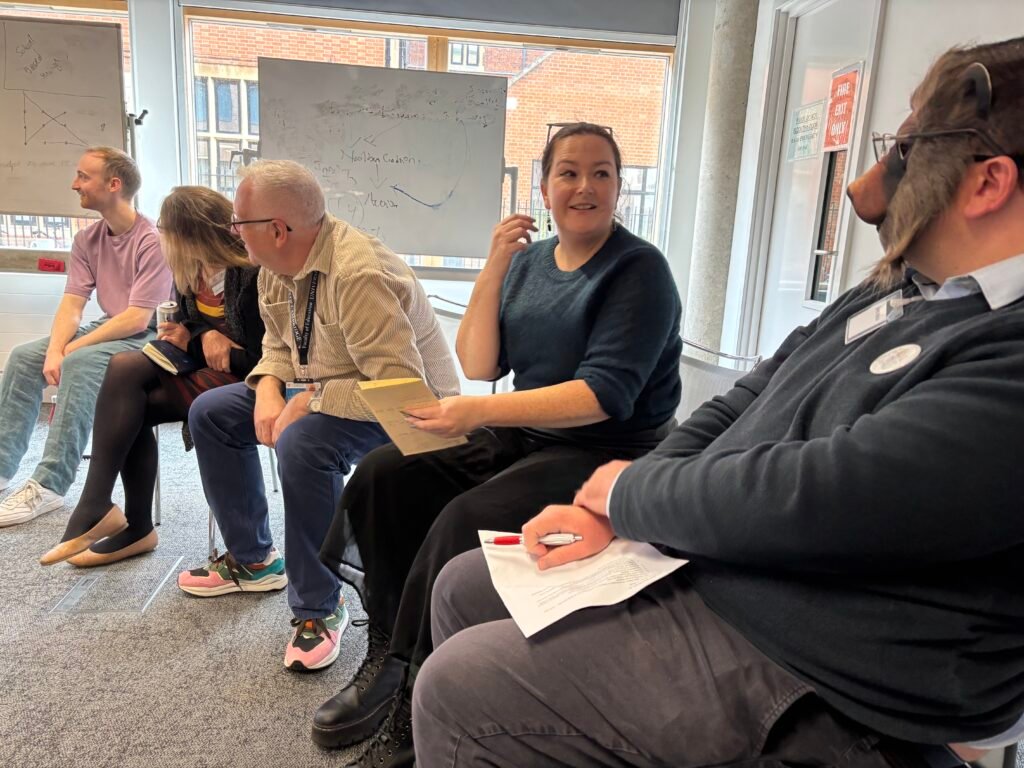
James, screenwriter for Doctor Who: The Fires of Pompeii, told us about the inspiration behind the inclusion of the CLC family in this episode. This was followed by a balloon debate co-hosted with Caroline. With Caecilius, Metella, Quintus and his new sister Evelina safely aboard the TARDIS during the iconic TV episode, and Cerberus and Grumio taken in before the start of the debate, Dumnorix (Lisa Hay), Euphrosyne (Ben Harris), Aristo (Ben Joffe), Clemens (Steve Hunt), the bear from Stage 16 (James Watson looking absolutely extraordinary in a bear mask), Rufilla (Julie Wilkinson) and Togidubnus (Mair Lloyd) vied for the final place aboard. After a promising showing by Clemens in the first round, Julie/Rufilla stole the show with her strong character denying responsibility for her villainous husband, Salvius.
And then there was cake!
Of course we sang happy birthday to Caecilius in Latin!
fēlīx diēs tibi sit,
fēlīx diēs tibi sit,
fēlīx diēs, Caecilī,
fēlīx diēs tibi sit!
The closing keynote
Dr Sophie Hay
From Amarantus to Aulus: Connecting Neighbours and Neighbourhoods in Pompeii
In this fascinating talk, Dr Sophie, who was the inspiration behind the archaeologist talking head in the latest edition of the Cambridge Latin Course, explained how her work on Insula I.9, undertaken with the British School at Rome and the University of Reading, casts light on the interconnectedness of individuals in Pompeii. Excavation of the bar of a freedman called Amarantus back in the 1990s underpinned the development of the Amarantus and his Neighbourhood project with CSCP. Her presentation showed how further excavation and exploration of the ties and links between the bar and other individuals has led to stunning new discoveries, notably those related to a man called Aulus.
All in all it was a wonderful day. We are already looking forward to our next big birthday!